Change Management: When Should You Use Kotter's Model, and When Should You Use ADKAR?
Change management is how you move people from an old way of working to a new one without stopping the work or losing them to old habits. Kotter's model plans change for the whole organization, while ADKAR shows where each employee is stuck. Use both.
12 min read
— abstract —
Change management is how you move people from an old way of working to a new one without stopping the work or losing them to old habits. Kotter's model plans change for the whole organization, while ADKAR shows where each employee is stuck. Use both.
— full text —
Change management is the way you move people from an old way of working to a new one without stopping the work, or having them slide back into their old habits. Kotter's model answers the leader's question: how do I move the whole organization? ADKAR answers a different question: where exactly is this employee stuck? It is best to use both.
Key takeaways
- Projects where the people side was managed well met or exceeded their objectives 88% of the time, against 13% when change management was poor (Prosci, 2023).
- Kotter's model is eight steps for the whole organization. It starts with a sense that change cannot wait and ends with anchoring it in the work culture.
- ADKAR is five stations every employee passes through: Awareness, Desire, Knowledge, Ability and Reinforcement.
- The hardest resistance does not come from laziness but from fear: the employee's fear that technology will take their place, and the fear of whoever holds control today that they will lose it.
- Change does not succeed without a senior sponsor who backs it and insists on it to the end.
What is change management, and why do projects fail without it?
Change management is everything you do so that people truly adopt the new way of working, not just learn it. Projects fail without it because a new system is installed in weeks, while changing people's habits takes months. Whoever ignores that pays for a system nobody uses.
Take a familiar example. A company buys a customer-management system and trains the team for a full day. A month later, employees enter data into the system because management asks them to, then carry on the real work by phone and in paper notebooks. The system exists, but the change never happened.
The numbers confirm the size of the gap. In Prosci's Best Practices in Change Management study (12th Edition, 2023), which surveyed 2,668 respondents, and in the benchmarking data Prosci has gathered from more than 10,800 respondents, projects with excellent change management met or exceeded their objectives 88% of the time. Projects with poor change management did so only 13% of the time. That makes the odds of success about seven times higher.
This agrees with what the reference guide on digital transformation strategy (in Arabic) says: the success of a transformation depends far more on people and on ways of working than on technology.
What is Kotter's model, and how does a small company owner apply it?
Kotter's model is a plan of eight steps for leading change across the whole organization. John Kotter, a professor of leadership at Harvard Business School, set it out in his book "Leading Change" in 1996. In a small company you do not need eight committees. You need eight clear decisions that the owner takes.
Kotter later developed his model in the book "Accelerate" in 2014, where the steps became "accelerators" that can work together, not only one after another. But the core idea stayed the same. Here is what the eight steps look like in a company of 15 employees run by its owner:
| Step | What it means | What it looks like in a small company |
|---|---|---|
| 1. Create a sense of urgency | Convince people that the current situation no longer works | The owner shows the team one painful number, such as how many customers' messages were lost this month |
| 2. Build a guiding team | A small, influential group that leads the change | The owner, plus two of the people their colleagues respect most |
| 3. Set a clear vision | A simple picture of the desired situation | One sentence: "Every customer request is logged in one place and answered within an hour" |
| 4. Communicate the vision | Everyone hears it and understands it | A short weekly meeting where the same vision is repeated |
| 5. Remove obstacles | Solve what stops people from applying it | An extra device, a missing permission, or an old task that gets dropped |
| 6. Create quick wins | A result everyone sees within weeks | Announcing the first week in which no request was lost |
| 7. Build on the gains | Widen the change after the start succeeds | Moving a second department to the new way |
| 8. Anchor the change in the culture | The new way becomes "our way" | The new way becomes part of training every new employee |
The step companies skip most often is the sixth. Without an early result that everyone can see, the team loses its enthusiasm, and the talk returns to "we were better before."
What is the ADKAR model, and how do you know where each employee is stuck?
The ADKAR model describes five stations every person passes through before adopting a change: Awareness, then Desire, then Knowledge, then Ability, then Reinforcement. Its practical value is that it identifies the station where the employee stopped, so you treat the real problem instead of repeating the training for everyone.
Jeff Hiatt, the founder of Prosci, developed ADKAR after studying patterns of change in more than 700 organizations. The name is made of the first letters of the five stations in English: Awareness, Desire, Knowledge, Ability and Reinforcement. Its core idea is that an organization changes only when its individuals change, one by one.
| Station | The question in the employee's mind | The sign you see | What to do |
|---|---|---|---|
| Awareness | Why are we changing at all? | "Work is going well, so why change?" | Explain the problem with an example from their own work, not with general numbers |
| Desire | What will I lose? | Agrees in the meeting but does not apply it | Listen to their fears honestly, and make clear what they personally will gain |
| Knowledge | How do I do this? | Asks the same questions every day | Short, practical training on their actual tasks |
| Ability | Can I really do it? | Knows the method but stumbles under pressure | Practice and follow-up in the first days, and a person to turn to |
| Reinforcement | Will this last? | Goes back to the old way when the person following up is away | Measure usage, thank those who comply, and close the old route |
The order matters here. An employee who "does not want to" will not benefit from extra training, because their problem is in Desire, not in Knowledge. This is the mistake I have seen repeated most: a second and a third training for an employee who is not missing information but a convincing reason.
What is the difference between Kotter and ADKAR, and when do you use each?
The difference is the angle of view. Kotter looks at change from the leader's office and asks how the whole organization moves. ADKAR looks at it from the employee's desk and asks what this person needs in order to change. So do not choose between them: use Kotter to plan and ADKAR to diagnose.
| Kotter's model | ADKAR model | |
|---|---|---|
| Who does it serve? | Leadership | Each employee individually |
| The question it answers | How do we lead the change? | Where is this person stuck? |
| Its shape | Eight steps for the organization | Five stations for the individual |
| When do you use it? | When planning and launching the change | When following up, and when resistance appears |
| Its weakness | It does not tell you why a particular person resists | It does not give you a plan to move the whole organization |
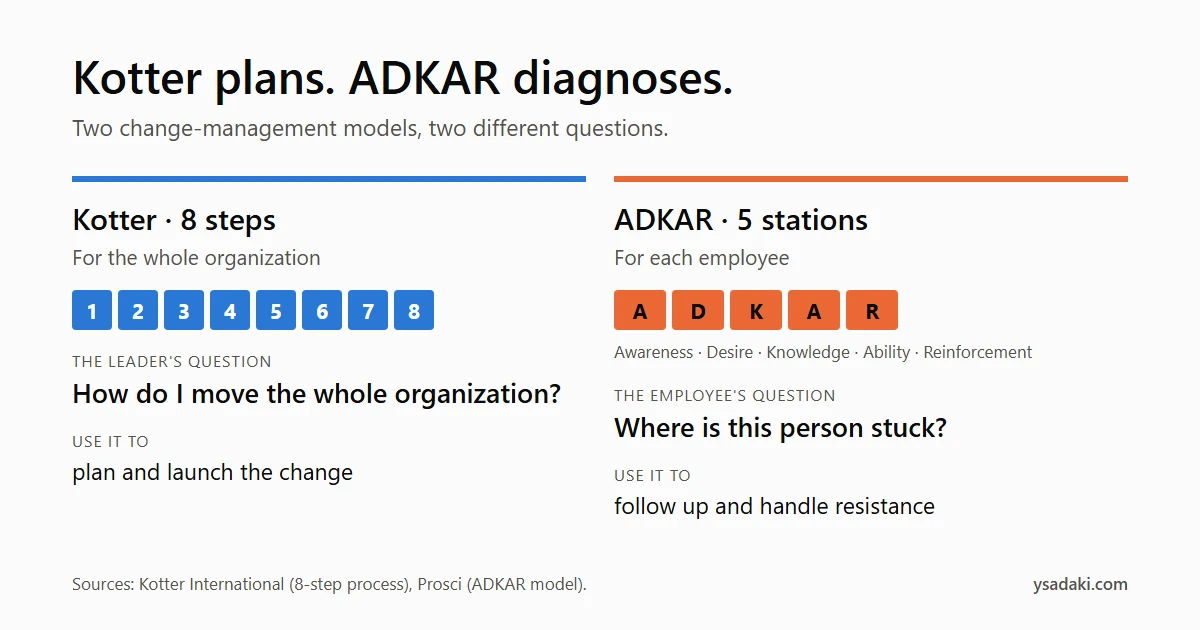
An example: at the launch you need Kotter's first steps: a sense of urgency, a guiding team and a clear vision. A month later, when you notice that one department is not applying the change, you open ADKAR and ask: are they missing Awareness, Desire or Ability?
What did we learn from moving a whole company from WhatsApp groups to one system?
We learned that the technology was the easy part. The new system was ready quickly, while changing how people communicate needed a clear decision from senior management and insistence on it. Without that insistence, the WhatsApp groups would have stayed the real place where the work happens.
For example, I worked with a large trading company that ran most of its daily work through WhatsApp groups: orders, follow-ups and the exchange of data between offices all passed through scattered messages. Information got lost among dozens of conversations, and nobody knew where its latest copy was.
When we started moving this work into an organized system, the problem was not learning the tool. The problem was that people had grown used to a certain way and felt safe in it. So refusal appeared, along with fear of the new tool.
What settled it was a decision from senior management and insistence on carrying it out. That is a direct application of Kotter's first two steps: management made the change something that cannot wait, and stood behind it personally.
Prosci's research points the same way. In its 12th Edition study (2023), active and visible sponsorship from senior management came first among the contributors to change success, and projects with an extremely effective sponsor met or exceeded their objectives more than twice as often as those with a very ineffective sponsor, and nearly three times as often by Prosci's own account. You can read the details in Prosci's article on the sponsor's role.
The result: we were able to shut down many of the groups, though not all of them, and a large part of the communication between offices, especially the exchange of data, moved to organized channels. The difference showed first in the teams that depend on the speed of information: the social media team, the replies team, the call center and customer service. Work became more organized, because every team now knew where to find the information.
Why do some employees resist even when the change is in their favor?
Because resistance is usually not about the tool but about what the person stands to lose. In our experience two fears appeared: the fear that technology will take the employee's place, and the fear of the person who controlled communication that they would lose that role. Each fear needs a different treatment.
The first fear: "Technology will take my place"
This fear sits in the Desire station of ADKAR. The employee does not refuse the tool because they do not understand it, but because they think its success means they will no longer be needed. The answer is not general reassurance. It is to show them which tedious work the tool will take off their hands, and what role will remain for them, or grow.
The second fear: "I am the one in control"
This fear is subtler. In every organization that works through groups, there are people through whom information passes. They know where the file is, and they decide when news is sent and to whom. That role gives them a sense of importance and control, even if it is not written in the official structure. An organized system makes information available to everyone who needs it, so these people feel they are losing their standing.
This is a small version of what we call the administrative bottleneck: one point everything passes through, so the whole organization slows down. The solution is not to confront these people but to give them a clear new role in the new system, such as being responsible for data quality or training their colleagues. Whoever takes a role in the change is less likely to resist it.
How do you start change management in your organization this month?
Start with one specific change, not a comprehensive program. Name the sponsor from management, create a real sense that the current situation is costly, then follow each employee through the five ADKAR stations. These are steps you can start this month, with no extra budget:
- Choose one change that really hurts, such as moving customer requests from WhatsApp to one place.
- Name the sponsor: a person from senior management who announces the change themselves and stays behind it to the end.
- Show one number that makes the cost of the current situation clear, such as the number of lost requests or the average response time.
- Set a first win within two or three weeks, and announce it to everyone.
- After a month, sit with each employee for five minutes and ask yourself: which ADKAR station are they at? Then treat that station alone.
If you are not sure where to start, begin by assessing your organization's digital maturity. If the change you need is bigger than you can lead alone, look at our digital transformation service, or talk to us.
Sources
All links were accessed on 2026-11-16.
- Prosci (2023). Best Practices in Change Management, 12th Edition: Executive Summary.
- Prosci. The Correlation Between Change Management and Project Success.
- Prosci. 7 Best Practices in Change Management.
- Prosci. Primary Sponsor's Role and Importance.
- Prosci. The Prosci ADKAR Model.
- Kotter International. The 8-Step Process for Leading Change. Kotter, J. (1996), Leading Change. Kotter, J. (2014), Accelerate.
— frequently asked —
- Does the ADKAR model suit small companies?
- Yes, and perhaps better than large ones. In a small company you know every employee by name, and you can identify each one's station in a short conversation. You do not need complicated measurement tools, only honest questions and attention to what the employee actually does.
- How long does change management take?
- There is no single duration, because it depends on the size of the change and the number of people it touches. But the practical rule is that installing the tool takes weeks, while embedding the new way takes months. That is why you need an early win in the first weeks, to keep enthusiasm alive until the change is complete.
- What is the most important factor in the success of change?
- The sponsor from senior management. In Prosci's 2023 study, active and visible sponsorship ranked as the top contributor to change success, and projects with an extremely effective sponsor met or exceeded their objectives more than twice as often as those with a very ineffective sponsor. The sponsor announces the change, removes obstacles and insists on it when resistance appears.
- What should I do with an employee who refuses the change?
- First identify the reason for the refusal. If they do not understand why we are changing, the problem is in Awareness. If they understand but fear what they will lose, the problem is in Desire. The common mistake here is giving everyone extra training, while the person who refuses usually needs an honest conversation about their place in the new way.
Author
Youssef Sadaki
Syrian-Canadian strategic digital transformation consultant and Middle East analyst, based between London, Ontario and Damascus. Published by the Atlantic Council, The Washington Institute for Near East Policy, The Century Foundation, Jadaliyya, and Arabic-language outlets including 7al.net.