How Much Do Meta Ads Cost in Syria in 2026? Ten Months of Real Account Data
In our accounts, showing a Meta ad in Syria cost about $0.044 per 1,000 impressions, roughly five times less than in Jordan. But price was not the biggest lever: the campaign objective moved the cost of a conversation from $0.87 to $0.10. Ten and a half months of data, and what it cannot tell you.
8 min read
— abstract —
In our accounts, showing a Meta ad in Syria cost about $0.044 per 1,000 impressions, roughly five times less than in Jordan. But price was not the biggest lever: the campaign objective moved the cost of a conversation from $0.87 to $0.10. Ten and a half months of data, and what it cannot tell you.
— full text —
In our accounts, showing a Meta ad in Syria cost about $0.044 per 1,000 impressions between December 2025 and October 2026, roughly five times less than in Jordan. But price was not the biggest lever. The campaign objective was. A conversation cost about $0.10 on Sales campaigns and about $0.87 on Awareness campaigns, so the same budget produced very different volumes depending on that one choice.
Key takeaways
- Showing an ad in Syria is cheap: about $0.044 per 1,000 impressions and $0.012 per link click, against $0.22 and $0.16 in Jordan.
- Awareness and Traffic campaigns took 80% of the budget but produced about half of the conversations.
- Sales campaigns set to open conversations took 5% of the budget and produced 28% of the conversations.
- One ad set per product cost $0.05 to $0.12 per conversation, against $0.83 for a generic ad set.
- These are conversations, not sales. We have no sales data, and you should not read them as promises.
Where do these numbers come from?
They come from three Meta ad accounts, exported from Ads Manager for 1 December 2025 to 15 October 2026. The first is a retail company selling electronics and home appliances in Syria and Jordan, with about $43,100 in ad spend and about 82,000 conversations started. The second is a medical clinic in Syria, with about $189 over 15 days. The third is our own set of small tests, about $127. The first account carries most of the weight, so the other two are illustrations, not proof.
Every figure is in US dollars. The retail account is billed in UAE dirhams, which are pegged at 3.6725 to the dollar, so that conversion is exact. The two Canadian-dollar accounts are converted at roughly 0.72, an approximation. No client is named, on purpose.
One definition matters. A "conversation" here means exactly what Meta counts as a messaging conversation started within seven days of seeing or clicking the ad. It is not a booking, a lead we qualified, or a sale.
How much does a Meta ad cost in Syria compared with Jordan and the UAE?
Showing an ad in Syria cost about $0.044 per 1,000 impressions and about $0.012 per link click in our accounts. In Jordan the same two numbers were $0.22 and $0.16, and in the UAE $0.30 and $0.32. Syria was about five times cheaper than Jordan per thousand impressions, and about fourteen times cheaper per click.
| Market | Share of our spend | Cost per 1,000 impressions | Cost per link click |
|---|---|---|---|
| Syria | 85.6% | $0.044 | $0.012 |
| Jordan | 13.3% | $0.216 | $0.160 |
| UAE | 0.8% | $0.298 | $0.322 |
Two caveats keep this honest. First, most of our impressions came from broad video and reach campaigns, which are cheaper per thousand than campaigns tuned for purchases, so these numbers sit well below published benchmarks. One 2026 benchmark roundup puts the global average at $6.59 per 1,000 impressions and the UAE at $6.50. Compare the markets with each other, not our numbers with someone else's. Second, the UAE spend was only about $366, so treat that row as a hint.
Cheap impressions also come with a ceiling. DataReportal's Digital 2026: Syria report, published by Kepios in November 2025, counts 9.25 million internet users in Syria, which is 35.8% of the population. Your audience is real, but it is smaller than the population figure suggests.
Does the campaign objective matter more than the price per impression?
Yes. In our data the objective decided the cost of a conversation more than the market, the placement or the audience did. Sales campaigns, where the goal was to open a conversation, cost about $0.10 per conversation. Awareness campaigns cost about $0.87, and Traffic campaigns about $0.82.
| Campaign objective | Share of spend | Share of conversations | Cost per conversation |
|---|---|---|---|
| Awareness | 52.4% | 31.7% | $0.87 |
| Traffic | 27.7% | 17.8% | $0.82 |
| Engagement | 14.2% | 22.2% | $0.34 |
| Sales (set to open conversations) | 5.2% | 27.9% | $0.10 |
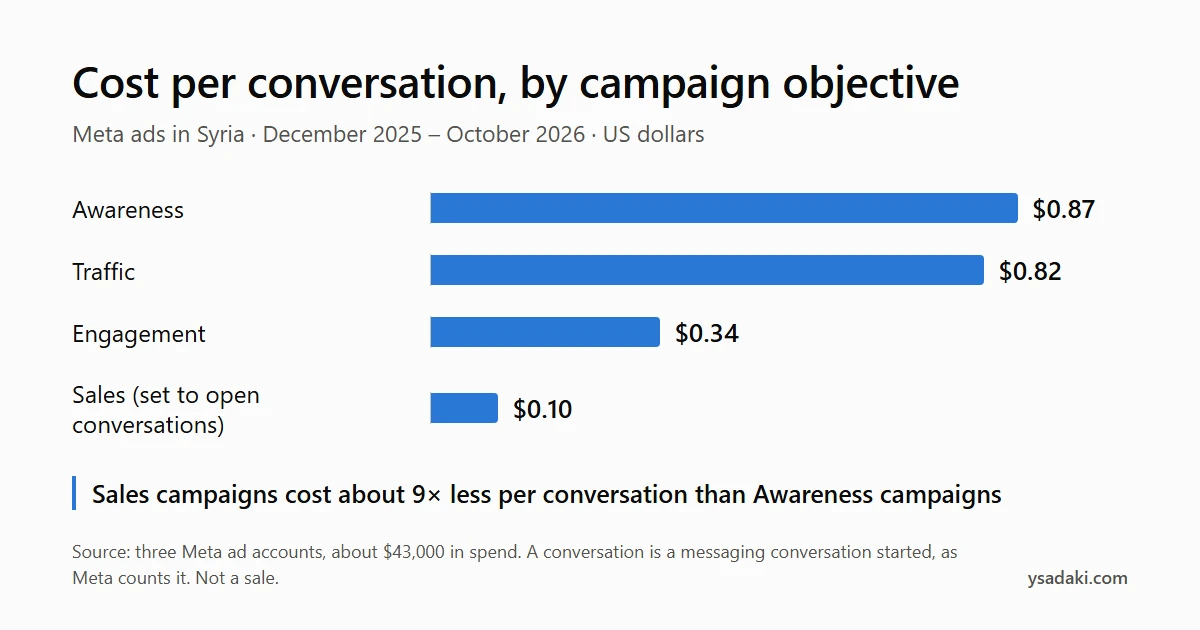
Put simply, Awareness and Traffic took 80% of the budget and produced about half of the conversations. The nine campaigns whose goal was a conversation took 5.5% of the budget and produced 40.5% of the conversations, at about $0.07 each. Meta delivers what you ask it to optimise for. If you ask for views, you get views.
Where did most of the budget go, and what did it cost?
Between January and April 2026 we put about $26,500, 61% of the whole budget, mostly into awareness, follower-growth and traffic campaigns. A conversation cost about $0.79 in those months. In September and October the share moved toward conversation-focused campaigns, and the cost fell to about $0.21.
Those early campaigns were not pointless. Many were tied to events, contests and launches, as their names show, and awareness is a legitimate goal for those. But if the goal is customers asking questions, then views are the wrong thing to buy. Our own small test shows the gap. A video-views campaign spent about $25 for 22,000 ThruPlays, seven link clicks and one conversation. A carousel campaign set to open conversations spent about $15.50 for 25 conversations, about $0.62 each.
Does one ad set per product work better?
Yes. In the retail account, ad sets built around a single product, such as an air fryer, a washing machine or a kettle, cost between $0.05 and $0.12 per conversation. A generic "everything" ad set cost about $0.83. A person who sees an ad for exactly the product they were thinking about is much more likely to write.
The clinic account points the same way on a smaller scale. It spent about $189 over 15 days across all its campaigns, including a call-button test, and opened 1,475 conversations at about $0.13 each, and its cheapest creative, a short weight-loss video, cost about $0.08 per conversation. For the full case, see how to choose a paid ads agency.
Which placements, ages and days perform best?
Facebook Feed was the cheapest large placement, at about $0.34 per conversation, while Reels on Facebook and Instagram cost about $0.75 to $0.83. Audience Network was the clear waste: between $8.50 and $13 per conversation, so switch it off. Part of the placement gap comes from which campaigns ran where, so read it as a direction, not a law.
By age, the cheapest conversations came from people aged 35 to 54, at about $0.45 to $0.47 each. The most expensive group was women aged 18 to 24, at about $0.81. Weekdays made almost no difference, with costs between $0.51 and $0.54 on every day of the week. Ramadan did not raise the price of reaching people either: cost per 1,000 impressions was $0.050 before Ramadan, $0.040 during it, and $0.037 after it.
How do you pay for Meta ads, and how much should you start with?
In our accounts the ad budget is paid by credit card directly to Meta. It is separate from any agency fee, as we explain in the paid ads agency guide.
For a starting budget, the clinic case suggests that about $100 to $200 over two weeks is enough to see which creative works, in a market where a conversation costs well under a dollar. That is one case, not a rule. Set the objective to conversations first, test two or three creatives, and judge them by cost per conversation, then by how many of those conversations turn into bookings.
What do these numbers not tell you?
They do not tell you how many conversations became customers, because we do not have that data. A conversation that costs one cent can be a person who tapped by accident, so cheap does not mean good. Our cheapest campaign opened over 10,000 conversations for about $93, and we treat that figure with caution until the sales side confirms it.
They also mix three accounts of very different sizes, and the CPM values come from broad campaigns that are not comparable with conversion-tuned ones. Use them to choose a direction, then measure your own account. This is why strategy comes before the ad, as we argue in why marketing fails when it starts from the ad. If you want help setting this up for a business in Syria, see the paid ads service or talk to us.
— frequently asked —
- How much do Meta ads cost in Syria in 2026?
- In our accounts, between December 2025 and October 2026, showing an ad in Syria cost about $0.044 per 1,000 impressions and about $0.012 per link click. A conversation cost between $0.10 and $0.87 depending on the campaign objective. These are results from our accounts, not a price list, and they will differ for your business.
- How do I pay for Meta ads for a business in Syria?
- In our accounts the ad budget is paid by credit card directly to Meta, and it is billed separately from any agency fee. Open the ad account in your own business name so the history and audiences stay with you. Check with your bank that the card works for online advertising before you start.
- Which campaign objective should I choose?
- Choose the objective that matches the result you want. If you want customers to write to you, use a Sales or Engagement campaign set to open messaging conversations. In our data these cost $0.10 and $0.34 per conversation, against about $0.85 for Awareness and Traffic campaigns. Use Awareness when the goal is truly to be seen, such as an event or a launch.
- Is a cheap conversation a real customer?
- Not necessarily. A conversation is a person who started a chat, and some of them are not serious buyers. Track how many conversations become bookings or sales, and judge the campaign on that number. We have no sales data for these accounts, so the figures here measure the cost of starting a conversation, not of winning a customer.
Author
Youssef Sadaki
Syrian-Canadian strategic digital transformation consultant and Middle East analyst, based between London, Ontario and Damascus. Published by the Atlantic Council, The Washington Institute for Near East Policy, The Century Foundation, Jadaliyya, and Arabic-language outlets including 7al.net.