How Do You Assess Your Organization's Digital Maturity, Step by Step?
A practical way to find your starting point before any technology spend: score ten areas from 0 to 3, turn the total into a 0 to 100 readiness score, read it against four bands, and compare it with the six maturity stages in the reference guide.
7 min read
— abstract —
A practical way to find your starting point before any technology spend: score ten areas from 0 to 3, turn the total into a 0 to 100 readiness score, read it against four bands, and compare it with the six maturity stages in the reference guide.
— full text —
You assess digital maturity by scoring a handful of concrete areas, each from 0 to 3, and reading the total before you spend on any technology. The ten questions below cover system integration, data, automation, KPIs, reporting, sales tracking, AI use, scalability, security and technology leadership. They turn into a 0 to 100 score you can act on.
Key takeaways
- Assess before you buy. The first of the eight most common mistakes in our reference guide is buying technology first and setting the goal later.
- Score ten areas from 0 to 3. The total out of 30 becomes a 0 to 100 readiness score.
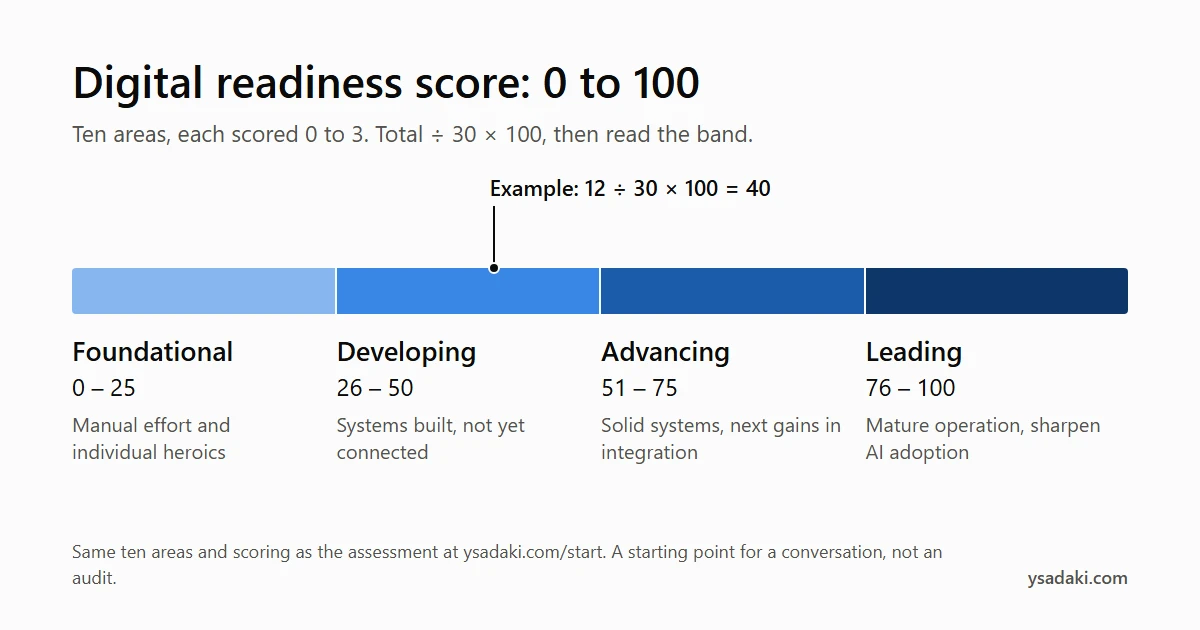
- There are four bands: foundational (0 to 25), developing (26 to 50), advancing (51 to 75) and leading (76 to 100).
- The score shows how ready your systems are. The six maturity stages describe how your organization behaves. Use both.
- Ask more than one person to answer, separately. The gaps between their answers are part of the result.
Why assess digital maturity before buying technology?
Because the real size of your project is the gap between where you are and where you need to be, not the number of tools you buy. Our reference guide (in Arabic) lists buying technology first and defining the goal later as the first of eight common mistakes, and an assessment is the quickest way to avoid it.
A digital maturity assessment asks people across an organization to rate how it works today in a set of defined areas, so that investment goes where the gap is. That is how TM Forum's Digital Maturity Model, announced in 2017, works: it covers five dimensions (customer, strategy, technology, operations, and culture, people and organization), and its results show where to improve and which investments to prioritize.
Which ten areas should you score?
These are the same ten questions as the assessment on our site. Each has four possible answers, scored 0 to 3. The table shows the two ends of the scale. A 1 means partly in place and a 2 means mostly in place.
| Area | The question | What a 0 looks like | What a 3 looks like |
|---|---|---|---|
| Integration | How do your core systems (sales, marketing, finance) talk to each other? | Siloed systems, data moved by hand | Fully integrated, in real time |
| Data truth | How much do you trust data across departments? | Every department has its own numbers | One source of truth for the whole company |
| Automation | How much human effort do repetitive tasks need? | Routine work and approvals by hand | Near-touchless workflows |
| KPIs | How do you track key performance indicators? | No clear KPIs | Real-time dashboards guide daily decisions |
| Reporting | How long does a full company report take? | Days, and several people | Accurate real-time reports in one click |
| CRM | How do you manage leads and the sales journey? | Spreadsheets, notes, the team's memory | An integrated CRM that tracks the customer lifecycle and triggers campaigns |
| AI governance | What is your policy on generative AI? | No AI use at all | A governance framework that embeds AI safely |
| Scalability | If sales doubled tomorrow, how would your systems cope? | They would collapse or need an army of staff | A scalable architecture absorbs it smoothly |
| Security | How are access and data protected? | Simple shared passwords | Strict, proactive policies with continuous monitoring |
| Technology leadership | Who directs technology strategy? | Nobody; it is left to individuals | Strategic leadership that builds a competitive edge |
Two of these deserve a second look. On technology leadership, the honest answer often depends on who decides what, which is the subject of the administrative bottleneck. And on AI governance, a rule that only says "use AI" without a habit of checking its answers scores low, as can you trust the AI's answer? explains.
How do you turn the answers into a score?
Each answer is worth 0 to 3 points. Add the ten answers (the maximum is 30), divide by 30, multiply by 100 and round. For example, answers that add up to 12 give 12 ÷ 30 × 100 = 40. Then read the result against four bands.
| Score | Band | What it usually means |
|---|---|---|
| 0 to 25 | Foundational | Growth still depends on manual effort and individual heroics. A few foundational systems unlock real leverage fast. |
| 26 to 50 | Developing | Systems are being built but are not yet connected. Closing the gaps between data, sales and marketing compounds results. |
| 51 to 75 | Advancing | Solid systems in several areas. The next gains come from integration, governance and a clear roadmap. |
| 76 to 100 | Leading | A mature operation. The opportunity is sharper AI adoption and removing the last inefficiencies. |
What should you do with the result?
Start from the lowest-scoring area, not the lowest total. It is usually the cheapest gain, and it is where the score is leaking. If you land in the foundational band, choose one problem that clearly hurts and can be measured within six months, instead of a whole platform. Our reference guide sets four conditions for a first project: a visible problem, data that is available, a result you can measure, and success you can repeat elsewhere.
How do the score and the six maturity stages fit together?
They measure different things. The score shows how ready your systems are today. The six stages in the reference guide, from "current state" to "permanent adaptation", describe how your organization behaves: whether leadership sees the need, whether efforts are coordinated, whether governance exists. The guide advises moving one stage at a time, because trying to jump two creates resistance that buries the project.
So use the score for a quick read of your systems, and the stage table in the guide to choose your next move.
What mistakes distort a self-assessment?
Four mistakes come up again and again.
- Scoring intentions instead of practice. "We plan to integrate our systems" is a 0 or a 1, not a 2.
- One voice. If only the owner or only the IT lead answers, the result is that one person's view. TM Forum's model asks stakeholders across the whole organization to assess each area for this reason, and you can do the same with three or four people answering separately.
- Rounding up. Ask for one example of evidence before you accept a 3.
- Treating the number as a grade. It is a starting point for a conversation, not a verdict.
How do we use this assessment at YSADAKI?
The assessment on our site uses these same ten areas and this same scoring. You answer ten multiple-choice questions, add a few company details that do not affect the score, and enter your contact details to see your 0 to 100 score and band. You then receive a personalized report that Youssef reviews before it is sent. The number comes from a fixed formula, not from AI. AI only helps draft the explanation.
We use it to open the diagnostic call. It is a conversation starter, not an audit, and it depends on your own answers. If the result points to a larger program, our digital transformation work and our advisory practice are where it leads.
— frequently asked —
- How do you assess digital maturity?
- Score ten concrete areas from 0 to 3, add the answers, divide by 30 and multiply by 100, then read the band. Ask several people to answer separately and ask for evidence behind every top score. Then compare the result with the six maturity stages in the reference guide to choose your next step.
- What is a good digital maturity score?
- There is no universal pass mark. The bands are foundational (0 to 25), developing (26 to 50), advancing (51 to 75) and leading (76 to 100). A good score is one that matches what your strategy needs, and for most organizations raising the weakest areas matters more than chasing a high total.
- How often should you reassess?
- In our view, every six months is a sensible rhythm for most organizations, and again after any major system change. Score the same ten areas each time, so you can see movement instead of getting a new number you cannot compare.
- Does a low score mean you should buy new software?
- No. A low score shows where your systems and habits are weak, and the first fix is often to define one goal, connect the tools you already have, or settle which numbers to trust. Buying technology first is the first of the eight common mistakes in our reference guide.
Author
Youssef Sadaki
Syrian-Canadian strategic digital transformation consultant and Middle East analyst, based between London, Ontario and Damascus. Published by the Atlantic Council, The Washington Institute for Near East Policy, The Century Foundation, Jadaliyya, and Arabic-language outlets including 7al.net.