Why Does Marketing Fail When It Starts From the Ad?
Marketing is built in three ordered layers: strategy, tactics, then execution. Starting from the ad skips the foundation; results must correct the strategy.
8 min read
— abstract —
Marketing is built in three ordered layers: strategy, tactics, then execution. Starting from the ad skips the foundation; results must correct the strategy.
— full text —
The order for building a company's marketing engine
The same scene repeats in many companies. The owner decides it is time for marketing, so they hire someone to run the social media accounts, set aside a budget for ads, and ask for daily posts. Three months pass, then six, and the numbers move a little, but sales do not. In the end the owner reaches a comfortable conclusion: "Marketing doesn't work in our field."
But most of the time the problem is not marketing itself; it is where it started. This company started from the last step and jumped over everything that should have come before it.
Marketing is built in three layers
You can picture a company's marketing as an engine, and this engine is built in three layers, each with a function no other layer performs.
The first layer is strategy, which sets the direction: where are we going, who are we speaking to, and why would anyone choose us. The second layer is tactics, which turns that direction into a practical plan: what do we publish, when, and where. The third layer is execution, which is what people see from the outside: the ads, the content, and the campaigns.
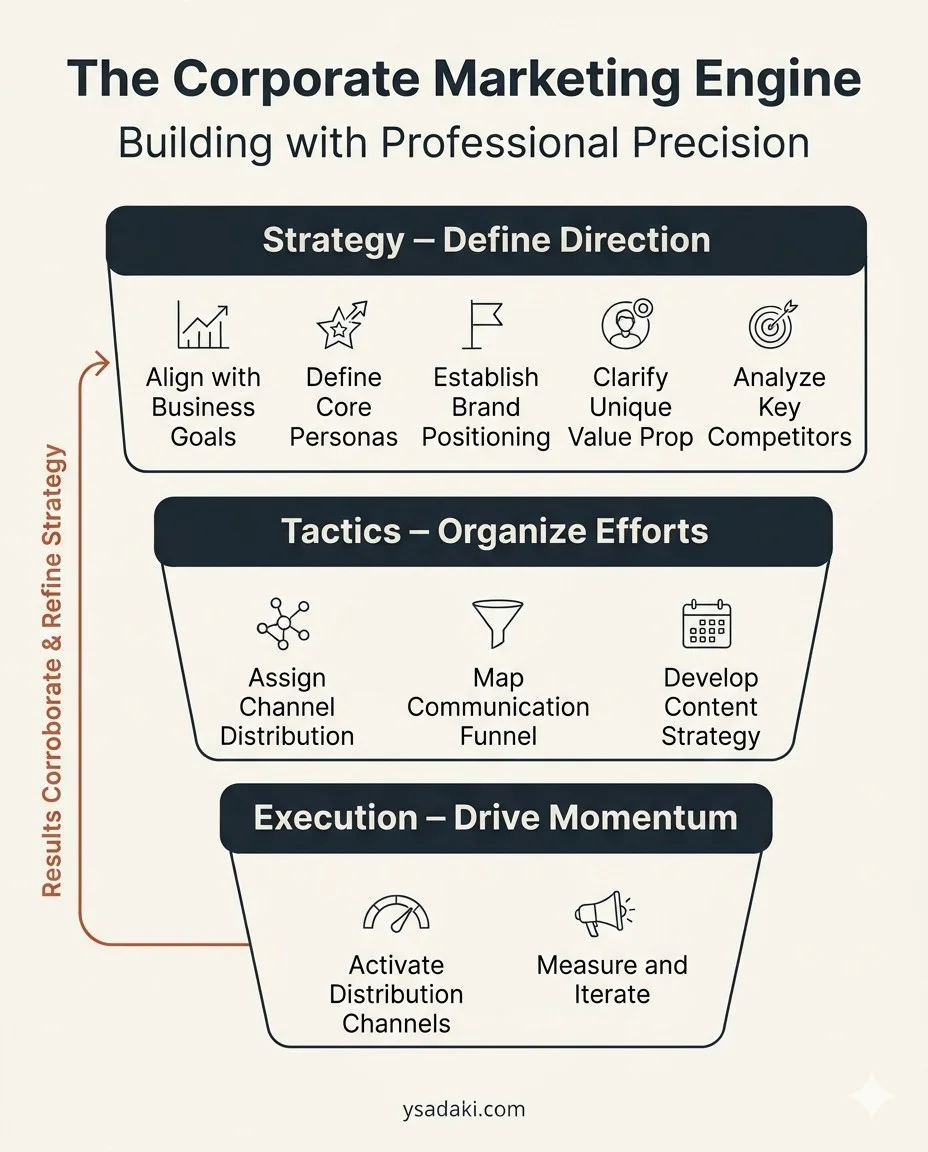
The problem is that execution is the only visible layer, so many people assume it is the whole of marketing. The truth is that execution without strategy is like a fast car with no steering wheel: it moves a lot, but it never arrives.
Here another danger appears that few people notice. When the strategy is unclear, additional channels do not solve the problem; they spread it. Every new platform carries the same confused message to a bigger audience, at a higher cost.
Layer one: strategy
First: marketing must start from the company's goals.
Before any campaign, the marketing team needs to know what the company actually wants over the coming year. Is the goal to grow sales in an existing market? To enter a new one? To launch a product? Each of these goals calls for entirely different marketing. A company that wants to enter the Canadian market does not market the way a company that wants to keep its customers in Damascus does.
Second: know your customer precisely.
It is not enough to say "our customers are small businesses." The real question is: who inside that company makes the buying decision? What keeps them up at night? And what event pushes them to look for a solution now rather than a year from now? This precise picture of the customer you want is called the Ideal Customer Profile.
For example, an IT services company might assume its customer is "any company that has computers." But the real customer may be a clinic manager whose network was breached last month and who is now looking for someone to protect it. The difference between the two descriptions is the difference between an ad that gets lost in the crowd and an ad that reaches the right person at the right moment.
Third: define your place in the customer's mind.
What problem do you want people to remember you for? When your customer faces that problem, does your name come to mind first? If you cannot answer this question in one sentence, your customer will not be able to either.
Some may ask: where does brand identity fit in all this? The answer is that it is born right here. The logo, the colors, and the tone of voice are not the starting point; they are the form your answer takes to the question: what is your place in the customer's mind? That is why a company that designs its identity before it knows this answer usually ends up with a beautiful logo that says nothing.
Fourth: your advantage must be real and clear.
Phrases like "outstanding service," "innovative solutions," and "powered by AI" mean nothing to the customer, because everyone says them. A real advantage is a clear reason for the customer to choose you. For example: "We respond to any outage within an hour," or "We deliver the website in three weeks at a fixed price." These are statements the customer can verify, and that is why they believe them.
Fifth: know your competitors honestly.
Who are the alternatives the customer considers before reaching you? Why do you lose some deals? And where do you have a real chance of winning? Sometimes your biggest competitor is not another company but the customer's decision to postpone, or to do it themselves.
Perhaps the most important benefit of strategy is that it tells you what not to do. When you know your customer and your advantage clearly, you can turn down the idea of a flashy campaign because it does not serve your goal, and you can stop posting on a platform where your audience does not exist. That way every marketing activity has a reason, instead of being one more task on a long list.
Layer two: tactics
Once the strategy is clear, the question becomes: how do we turn it into work?
The content plan is the first step. Instead of random daily posting, the strategy becomes specific topics, suitable formats, and a steady publishing rhythm. If your customer worries about the security of their data, the content must answer that worry, not merely celebrate holidays.
The communication roadmap is the second step. When do we launch the campaign? With what message do we begin? And what proof do we offer? Successful campaigns are built in sequence; they are not launched all at once.
Channel allocation is the third step. How much do we rely on paid ads? How much on search and content? How much on partnerships? There is no single correct ratio for all companies, but there is a correct ratio for yours, and it is derived from the strategy, not copied from another company.
Layer three: execution and measurement
Only here do the channels come in: search engine optimization, ads, direct outreach, and social media platforms. And when execution comes in its proper place, the results change visibly.
In our work with Western IT in Canada, we did not start with ads. We started with a question: what does the customer search for when they worry about their company's security? Then the content and the pages were built around that question specifically. The result was that the company reached first place in local search results for cybersecurity phrases, ChatGPT began recommending it to those who ask, and contracts were closed with clients who came directly from those recommendations.
But execution is not the end of the road. The last step, and the most neglected, is to bring what you have learned back to the beginning.
And the richest source of that learning is not the dashboard but the sales calls. Numbers tell you what happened, but the customer on the call tells you why it happened. They tell you the words they use to describe their problem, the objection that makes them hesitate, and the competitor they were considering. And those same words are the best copy you can write for your next ad.
We saw the value of this in the Al-Boraq experience, when a customer relationship management system was built from scratch and gathered about four hundred thousand contacts within four months. The value of that number was not its size, but that it made every later marketing decision rest on real data, not on guesswork.
The engine runs in a circle
This order may look like a straight line that starts at strategy and ends at execution, but in reality it is a circle. Strategy guides tactics, tactics drive execution, and the results of execution come back to improve tactics and then correct the strategy. A company that breaks this circle at any point ends up back in the scene we began with.
Before you run your next ad
Perhaps the most important question is not "how much do we spend on ads?" but "do we know who we are advertising to, and why they would choose us?"
If the answer is clear, the ad will work. If it is not, a bigger budget will not fix the problem; going back to the first step will.
The idea for this article was inspired by a visual model of building the marketing engine in companies, created by Hany Sewilam.
— frequently asked —
- Why does marketing fail when it starts from the ad?
- Because the ad is only the visible last layer of the marketing engine. A company that starts there skips the strategy that defines its goals, its customer, and its advantage, and the tactics that turn that strategy into a plan. Without them, every new channel spreads the same confused message to a bigger audience at a higher cost.
- What are the three layers of a marketing engine?
- Strategy sets the direction: where the company is going, who it speaks to, and why anyone would choose it. Tactics turn that direction into a practical plan: the content plan, the communication roadmap, and channel allocation. Execution is what people see: search visibility, ads, direct outreach, and social media, plus measurement.
- What does the strategy layer include?
- Five things: starting from the company's goals, knowing the customer precisely, defining the company's place in the customer's mind, making the advantage real and clear, and knowing competitors honestly. Brand identity is born here as the form the answer to "what is your place in the customer's mind?" takes.
- What is an Ideal Customer Profile?
- It is a precise picture of the customer a company wants: who inside the customer's organization makes the buying decision, what worries them, and what event pushes them to look for a solution now rather than a year from now.
- Why should execution results return to strategy?
- Because marketing works as a circle, not a straight line. Numbers show what happened, but sales calls show why it happened: the words customers use for their problem, the objections that make them hesitate, and the competitors they considered. That learning corrects the tactics and then the strategy.
Author
Youssef Sadaki
Syrian-Canadian strategic digital transformation consultant and Middle East analyst, based between London, Ontario and Damascus. Published by the Atlantic Council, The Washington Institute for Near East Policy, The Century Foundation, Jadaliyya, and Arabic-language outlets including 7al.net.