The Administrative Bottleneck: From Personal Centralization to the Digital Institution
An analysis of the "administrative bottleneck" produced by centralization and micromanagement: diagnosing the problem, its theoretical frame, the particularity of the Syrian case, and a roadmap out through delegation, succession planning, and digital transformation.
7 min read
— abstract —
An analysis of the "administrative bottleneck" produced by centralization and micromanagement: diagnosing the problem, its theoretical frame, the particularity of the Syrian case, and a roadmap out through delegation, succession planning, and digital transformation.
— full text —
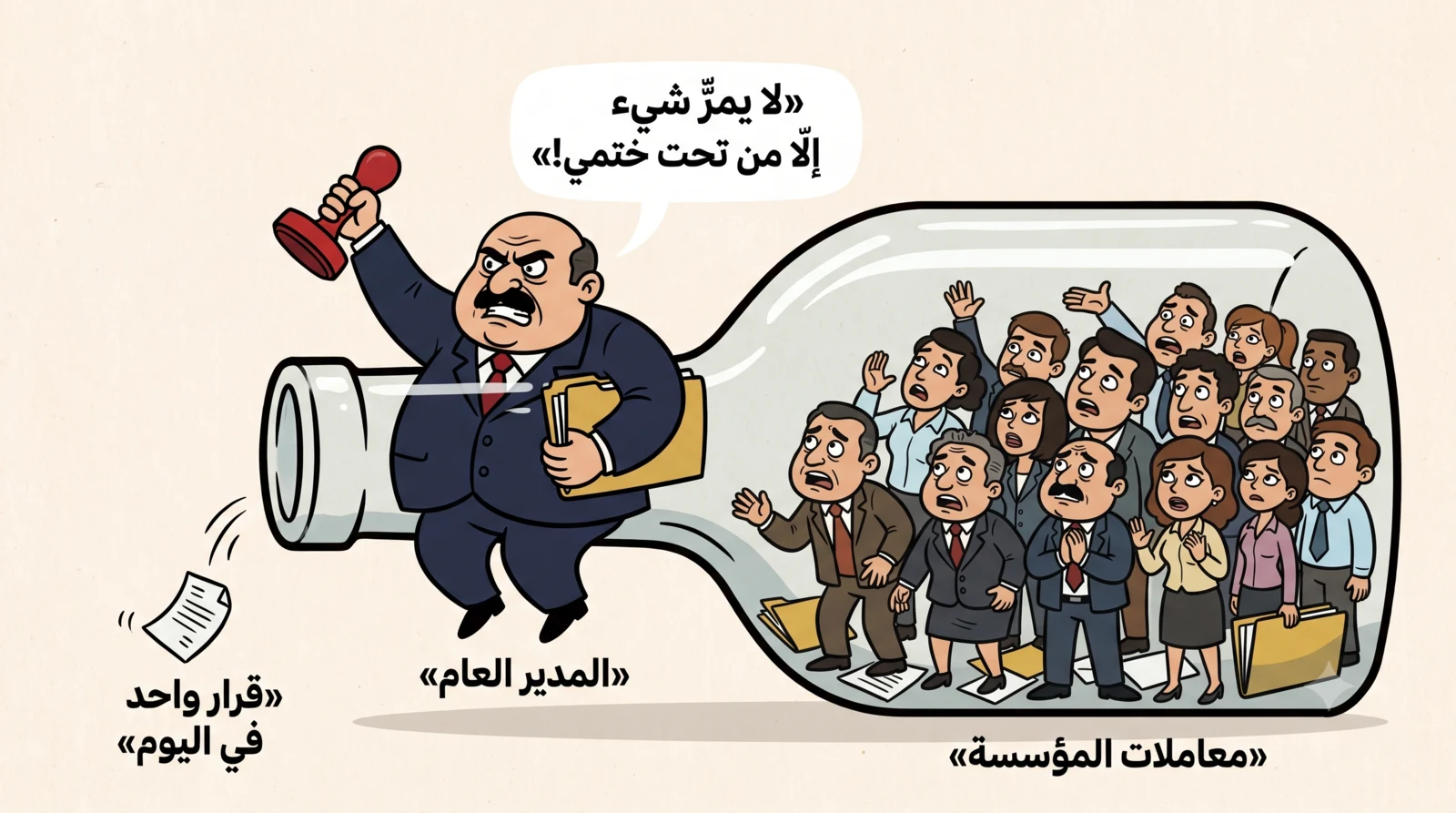
Picture a scene you have almost certainly lived: hiring decisions frozen for weeks, a purchase order stalled, a promising initiative sitting untouched in a drawer — all because the general manager is traveling and no one else may sign. The moment he returns, the institution springs back to life, so his presence looks like a blessing. It is, in fact, the clearest symptom of a deep organizational illness.
This is the administrative bottleneck (Managerial Bottleneck): a point in the decision structure where incoming transactions exceed the decision-maker's capacity to absorb them, so the entire institution slows because everything must pass through a single neck. It is not bad luck. It is the direct result of a design choice — and design choices can be reversed.
Key Takeaways
- The administrative bottleneck is an organizational design choice, not a cultural fate — and it is correctable.
- The manager is the highest point of leverage in any institution: Gallup (2015) found managers account for at least 70% of the variance in employee engagement.
- The root is behavioral before it is structural: leaders who delegate multiply their teams' capacity; those who hoard decisions suffocate it.
- The way out runs on three simultaneous tracks: law that widens delegation, a culture that redefines managerial success, and digitization that makes decentralization safe.
When the Manager Becomes the Single Point of Failure
When every transaction passes through one desk, the manager stops being a leader and becomes a choke valve. Andrew Grove, who ran Intel at its height, built his management philosophy on a simple truth: a manager's time is the scarcest resource in the organization. Spend it on details others could handle, and he turns into a single point of failure — the institution stalls the moment he steps away.
You can diagnose the bottleneck by three unmistakable signs:
- Decisions freeze while minor operational details wait for approval.
- There is no formal delegation of authority at all.
- Business continuity depends on the presence of one particular person.
The stakes are higher than they look. In 2015, Gallup's State of the American Manager report found that managers account for at least 70% of the variance in employee engagement scores across business units. The number lays the truth bare: the managerial seat is the highest point of leverage in any institution — and the most dangerous when it hardens into a bottleneck.
Why We Resist Delegation: A Behavioral Root Before a Structural One
Before the bottleneck is a problem in the structure, it is a problem in the manager's head. Douglas McGregor drew the line between a manager who assumes employees dodge responsibility and cannot be trusted with a decision — and therefore polices every move — and one who assumes the opposite and grants room to act. The first assumption builds an institution paralyzed by absent trust.
Liz Wiseman put her finger on the real cost of that pattern: a leader who believes he alone can get things done diminishes his team's intelligence and wastes it, while a leader who trusts and delegates multiplies his institution's capacity. The irony is that many managers think they are protecting the institution when they are quietly draining it.
"The leader who hoards the decision does not protect his institution — he sets a ceiling on its growth with his own hand."
Centralization is a two-way street. When employees grow used to the manager solving everything, they hand their decisions — their "monkeys" — back to him, and he drowns in their details while they wait, motionless. The cure is to teach each person to carry his own monkey. At a deeper level, there is a difference between authority drawn from office and documented procedure and authority drawn from the person; many of our institutions wear the form of the first and are run by the logic of the second.
A Double Centralization: What Makes the Syrian Case Distinct
In Syrian institutions — commercial and governmental alike — the bottleneck is doubled because it rests on two layers. The first is structural and legal: regulations that confine signing and disbursement authority to the top of the pyramid and place the entire burden of any initiative outside the text on the employee alone. The second is behavioral and cultural: a refusal to delegate even within what the regulations permit, and a view of the capable deputy as a threat to one's position rather than a guarantee for the institution.
That second layer is what the management literature calls Founder's Syndrome: a leader who refuses to give up centralization and, in doing so, sets a ceiling on what he built. The result is that institutional knowledge stays trapped in individual memory instead of becoming documented, transferable knowledge — and when the individual leaves, the institution leaves with him.
From the Individual to the System: Engineering Succession
An institution escapes its captivity to individuals by turning delegation from a personal favor into a deliberate system. Grove called this "managerial leverage": moving the manager from doing the work himself to raising the yield of his hour by building processes that do not need his constant presence. The executive tool for this is succession planning, and it rests on four sequential steps:
- Define the key positions independently of the people currently holding them.
- Evaluate promising individuals by leadership readiness, not seniority or loyalty.
- Build learning paths and graduated delegation under supervision.
- Adopt systems that document processes and transfer knowledge.
The framework is completed by a simple principle called management by exception: delegate routine decisions within clear, pre-defined standard limits, and confine senior-management intervention to the deviations alone. The manager gets his time back; the team gets its professional dignity back.
Digitization Makes Decentralization Safe
Digital transformation is not a technical luxury; it is the most realistic entry point for dismantling the bottleneck — not because it replaces the manager's will, but because it lowers the cost and risk of delegation until the structural pretexts for centralization collapse. Once distributing a decision becomes documented and safe, holding on to centralization loses its last justification.
Four digital levers make the difference:
- Workflow automation distributes decisions through a role-based authority matrix instead of routing every transaction to one office; the electronic signature ends the physical monopoly of pen and stamp.
- Audit trails address the root of the employee's fear: every delegated decision is documented with its context, timing, and rationale, so accountability becomes a procedure that protects the diligent before it calls the negligent to account.
- Dashboards move the manager from disabling prior control to subsequent oversight without losing visibility — management by exception in practice.
- Knowledge-management systems turn individual expertise into an institutional asset that does not leave when its owner does.
Digitization does not promise to abolish centralization, but it makes decentralization the least costly and safest option — and that alone is enough to flip the equation.
Conclusion: Exceptional Systems, Not Exceptional People
W. Edwards Deming, the spiritual father of Total Quality Management, distills the whole matter into a single line:
"A bad system will beat a good person every time." — W. Edwards Deming
The overwhelming majority of performance problems come from the system, not from individuals. The bottleneck, then, is not a cultural fate but a design choice, correctable on three simultaneous levels:
- Legally: by widening the scope of delegation and protecting the diligent employee in law.
- Behaviorally: by redefining a manager's success as his institution's ability to function in his absence.
- Technically: through a digital transformation that makes distributing the decision possible, safe, and auditable.
Enduring institutions are built on exceptional systems, not exceptional people. If building that system is your institution's next challenge, that is exactly what we work on in the practice.
References
- Grove, A. (1983). High Output Management. Random House.
- Oncken, W. & Wass, D. (1974). "Management Time: Who's Got the Monkey?" Harvard Business Review.
- Wiseman, L. (2010). Multipliers: How the Best Leaders Make Everyone Smarter. HarperBusiness.
- McGregor, D. (1960). The Human Side of Enterprise. McGraw-Hill.
- Nonaka, I. & Takeuchi, H. (1995). The Knowledge-Creating Company. Oxford University Press.
- Deming, W. E. (1993). The New Economics for Industry, Government, Education. MIT Press.
- Gallup (2015). State of the American Manager: Analytics and Advice for Leaders. Gallup, Inc.
— frequently asked —
- What is the administrative bottleneck?
- The administrative (managerial) bottleneck is a point in the decision-making structure at which incoming transactions exceed the decision-maker's absorptive capacity, so work accumulates and the completion cycle of the entire institution slows down. It usually arises from micromanagement and the routing of every decision through a single person.
- What is the difference between micromanagement and delegation?
- Micromanagement is requiring employees to obtain the manager's approval on the finest operational details, whereas delegation is granting specific administrative levels the authority to make routine decisions within clear standard limits, while confining senior-management intervention to the exceptions.
- How does digital transformation solve the problem of administrative centralization?
- Digital transformation lowers the cost and risk of delegation through workflow automation, the digital distribution of authority by role, electronic signatures, audit trails that protect the delegated employee by fully documenting his decisions, and dashboards that move the manager from prior control to subsequent oversight.
- What is succession planning?
- Succession planning is a four-step administrative framework: assessing the key positions, evaluating promising individuals by leadership readiness, building learning and development paths with graduated delegation, and adopting the supporting systems and tools — with the aim of building an institution that does not stop when people leave.
Author
Youssef Sadaki
Syrian-Canadian strategic digital transformation consultant and Middle East analyst, based between London, Ontario and Damascus. Published by the Atlantic Council, The Washington Institute for Near East Policy, The Century Foundation, Jadaliyya, and Arabic-language outlets including 7al.net.